Rhodesian Ridgeback (F) – 2 years neutered
Full report drawn up
Video and photos produced at 1.5 hour assessment
Vets had previously found nothing obviously to report
This dog had always seemed “laid back” and his caregiver had found him less willing to move with energy on walks. During video sessions the dog was reluctant to engage enthusiastically and was not happy on slippery floors, although the dislike of slippery flooring is common in most dogs. These things did not mean he did not play but as the video taken showed, there appeared to be stilted movements and some difficulties which then showed up in further stiffness after playful or more energetic moments.
On meeting up to work with F he was highly reluctant to move and this did not appear to be due to any anxiousness, but rather a reluctance to move. He would plant and look unhappy to move, he would then lie down without wishing to sit – all of which appeared awkward. Rather than explore and sniff a new environment in a hired dog field with many trees, his preference was to lie down and try to return to the car. In my experience, this is not a usual dog behaviour unless they are very fearful and certainly young 2 yo Ridgebacks are generally much more full of life – certainly in my experience of having lived and worked with Ridgebacks myself for well over 20 years.
F showed signs of uneven movement from the start but this became more obvious the more he moved around and after play. The video also shows some movement outside and the reluctance to move along with his awkward way of trying to sit and what appears to be less desire to put weight on his right leg.
When standing he often doesn’t stand on the main pads on the right hind with the foot in an upright position but seems to flatten out the foot – a bit like one might see in an older dog where the feet “sag”.
When standing eg to drink eat at the raised platforms, rarely stands square but rather the right hind is nearly always trailing – slightly behind and out or held slightly forward, with most of the weight being taken on the left hind.
The left hip seems to swing the left hind forward more with a shorter stride on the right – the nails of the right hind are often heard to “drag” when bringing that foot forward.
The walk is more like a hip swing rather than bending and pushing of the legs
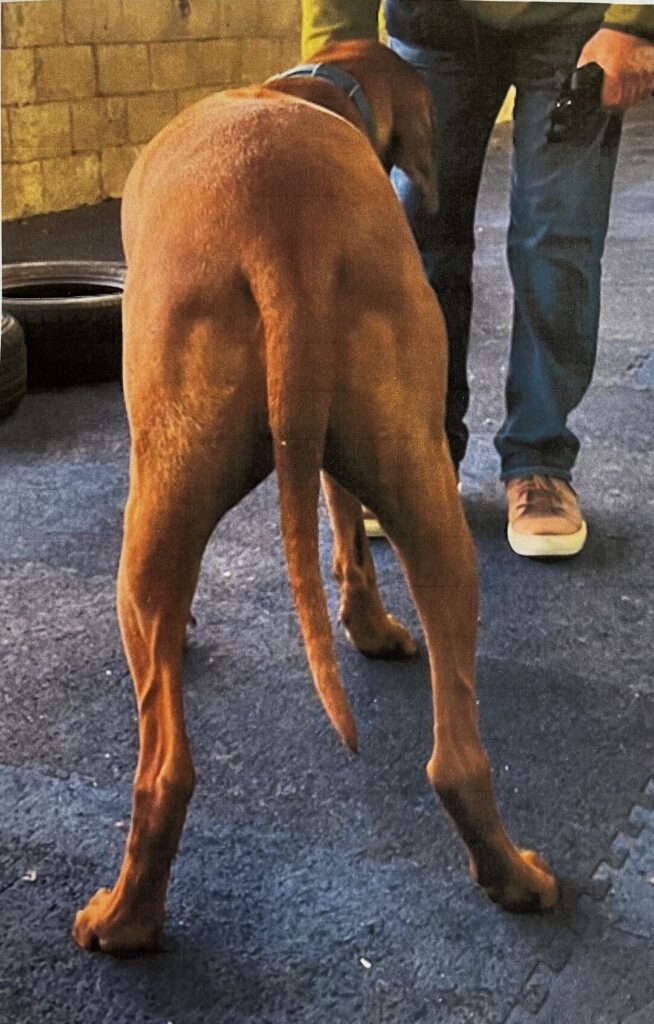
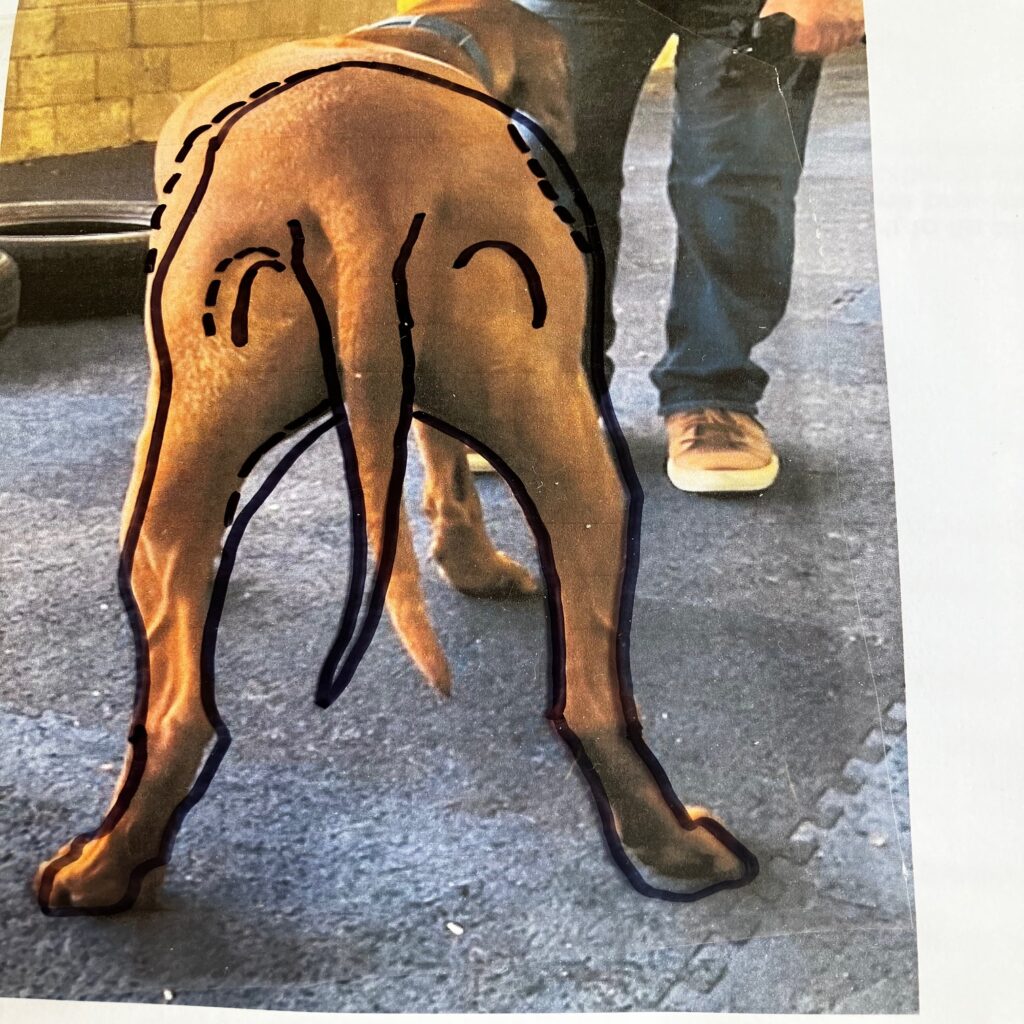
The muscles of the left hind thigh are more defined and larger than those on the right (see photos and overlay)
When sitting he is clearly sitting more on the left haunch – he is very uneven and this can be seen clearly in the photos both in front and behind.
Outside videos taken in the field clearly show what appears to be difficulty/discomfort in sitting or going to lie down.
Very often prefers to lie down rather than sit and if sitting does not seem able to maintain it for long.
Outcome after veterinary investigation:
Malformed sacral vertebra discovered. F visited an orthopaedic specialist after x-rays and MRIs were done. The specialist also conducted his own physical examination. His opinion was that surgery is too risky given the proximity of the malformed sacral vertebrae to the nerve. He has prescribed gabapentin in addition to the meloxidyl he was already taking. He additionally suggested that his exercise remains short and frequent as opposed to longer walks. Awareness to be placed on how this can affect behaviour and reactivity to other dogs especially any potential for dogs bumping into F.